We drove around Tenterfield to look at the old buildings. It's nice to see that the country towns have preserved their past so well.
Glen Innes was south. It had a huge number of well preserved buildings and a bustling down town. Glen Innes was settled by Scots, Irish, Welsh and Celtic people from France and Spain. Every year they have a Celtic festival to honor one of the groups. In a park on the edge of town were the Australian Stones. These were erected in the 1990s to honor the Celtic roots of the community.
There were 40 huge stones in a field. In the center was the Australis stone, with the Gaelic stone (for Scotland, Ireland and Isle of Mann) on one side and the Brythonic stone (for Wales, Cornwall, and Brittany) on the other. 24 stones, representing the hours in a day, were arranged in a circle around them. 4 stones outside of the circle marked North, South, East and West. 3 stones marked winter solstice sunset and summer solstice sunrise and sunset. 4 stones formed a path for the winter solstice sunrise. Stone 39 was the Irish stone, with an inscription in Ogham language. 40 was the Gorsedd stone, a flat stone used for ceremonies. It was all fascinating.
There was a stone 'crofters cottage' next to it where we had some coffee and Irish porter cake and Scottish Dundee cake.
Then we headed into the Great Dividing Range again. We stopped at an overlook for lunch and there were mountains as far as we could see. Fortified, we traveled the long, really winding, way down the mountains. It took a couple of hours.
That led us to Grafton. We just made a couple of stops there. According to our guide book the Grafton Gaol (pronounced 'jail') was notorious. The man at the visitor center said it was indeed notorious for having the worst of the worst criminals. It was in use until the 1960s. On Breimba St, a man planted two rows of fig trees in 1874. Now they are protected by the National Trust. We didn't drive down the street because the trees overhung the road so much, but they were impressive.
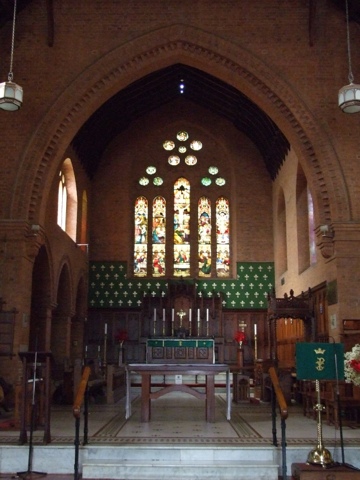
Our last stop was Christ Church Cathedral, a big brick building with beautiful stained glass windows. Some were installed when the church was built in the early 1900s, and others at different times. It was interesting to see the different styles of windows.
As we were leaving a man stopped us. He told us that when the bricklayers were working on the church, a girl and her mother walked by. The girl had a doll and she asked the bricklayer if he would put the doll in the wall. He did and it is in the front wall near the peak of the roof.
Now we're by the coast in Woogoola.
Pictures - Dragon fruit, Inside, Cottage in Tenterfield, Tenterfield RR Station, Glen Innes, Glen Innes Town hall, Stones Sign, Jeanne and center stones, View from a hill, View of Great Dividing Range, Grafton Gaol, Fig trees, Christ Church cathedral, Interior
Tuesday, June 4, 2013
Monday, June 3, 2013
June 3, Lennox Head, Ballina, Lismore, Casino, Tenterfield
No one kicked us out of our place last night, but we did have a warning ticket on the windshield.
It was bright and sunny this morning and the sea looked beautiful. There were people walking the beach very early. We drove down to Ballina and had a look at the lighthouse there.
Outside of town we stopped at Thursday Plantation. While we waited for it to open, we tried our hand at the maze. It took a lot of wrong turns, but we finally found our way out. Inside we watched a film about the beginning of the plantation. The aborigines used crushed tea tree leaves on cuts and sores. Captain Cook made a tea from the leaves and named it tea tree. The plantation is now TP Health and it produces a number of essential oils and herbal remedies.
We drove up into the mountains, past beautiful views to Lismore. We went to a lookout that was in our guidebook, but it was a view of the town. The next town we came to was Casino. St Marks Church of England was a lovely old building with some new stained glass windows. The gentleman who let us in told us we should have been there last week because the town was celebrating Beef Week and the church was decorated with flowers and with tableaux of drovers at a campfire. The town had recently celebrated its bicentennial and had a mural painted depicting the old town.
After lunch we had a long drive on a winding and sometimes steep road to Tenterfield. The speech that led to Australian federation was made here. The bushranger, Captain Thunderbolt, spent his career stealing horses in this area. And the singer and songwriter, Peter Allen, was born here.
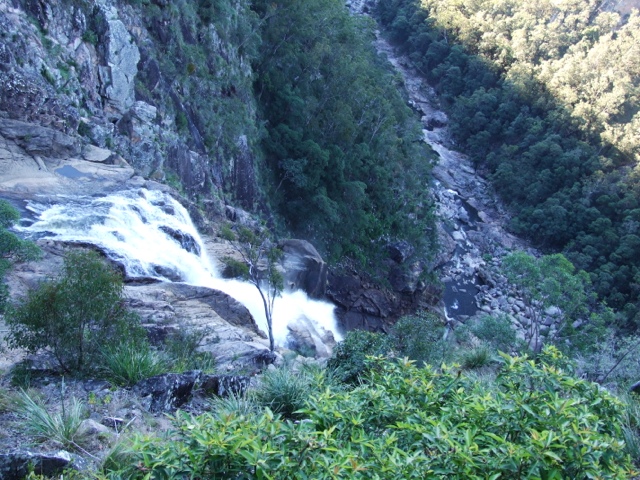
We headed north of town to Bald Rock National Park. The rock is the largest granite rock in Australia. We took the trail to look at it, but didn't take the long walk to the summit. It reminded us of Stone Mountain in Georgia. Just down the road was Boonoo Boonoo National Park. It was a 14 km dirt road to the car park. We almost turned back, but we stopped to ask about it and the man convinced us to go on. It was worth the trip. Walking down the trail we heard water rushing and saw cascades. We turned a corner and could see the waterfall as it plunged over the cliff. The water came from the New England tableland and dropped down the face of the escarpment.
On the way back to town we saw lots of kangaroos and wallabies. Most of the time they moved away from noise of the motorhome. But a couple of kangaroos jumped in front of us. Luckily Samson was able to avoid them.
Pictures - Lennox head, St Marks in Casino, Casino Community Centre and mural, Samson on Bald Rock, Boonoo Boonoo Upper Falls, Boonoo Boonoo Lower Falls
It was bright and sunny this morning and the sea looked beautiful. There were people walking the beach very early. We drove down to Ballina and had a look at the lighthouse there.
Outside of town we stopped at Thursday Plantation. While we waited for it to open, we tried our hand at the maze. It took a lot of wrong turns, but we finally found our way out. Inside we watched a film about the beginning of the plantation. The aborigines used crushed tea tree leaves on cuts and sores. Captain Cook made a tea from the leaves and named it tea tree. The plantation is now TP Health and it produces a number of essential oils and herbal remedies.
We drove up into the mountains, past beautiful views to Lismore. We went to a lookout that was in our guidebook, but it was a view of the town. The next town we came to was Casino. St Marks Church of England was a lovely old building with some new stained glass windows. The gentleman who let us in told us we should have been there last week because the town was celebrating Beef Week and the church was decorated with flowers and with tableaux of drovers at a campfire. The town had recently celebrated its bicentennial and had a mural painted depicting the old town.
After lunch we had a long drive on a winding and sometimes steep road to Tenterfield. The speech that led to Australian federation was made here. The bushranger, Captain Thunderbolt, spent his career stealing horses in this area. And the singer and songwriter, Peter Allen, was born here.
We headed north of town to Bald Rock National Park. The rock is the largest granite rock in Australia. We took the trail to look at it, but didn't take the long walk to the summit. It reminded us of Stone Mountain in Georgia. Just down the road was Boonoo Boonoo National Park. It was a 14 km dirt road to the car park. We almost turned back, but we stopped to ask about it and the man convinced us to go on. It was worth the trip. Walking down the trail we heard water rushing and saw cascades. We turned a corner and could see the waterfall as it plunged over the cliff. The water came from the New England tableland and dropped down the face of the escarpment.
On the way back to town we saw lots of kangaroos and wallabies. Most of the time they moved away from noise of the motorhome. But a couple of kangaroos jumped in front of us. Luckily Samson was able to avoid them.
Pictures - Lennox head, St Marks in Casino, Casino Community Centre and mural, Samson on Bald Rock, Boonoo Boonoo Upper Falls, Boonoo Boonoo Lower Falls
Saturday, June 1, 2013
June 2, Gold Coast, Tweed Head South, Byron Bay
Today we drove out to the coast and south. First we had to drive through the mountains to get to the Gold Coast. This the is premiere Pacific resort area of Australia. Towns stretch along the coast by the many beaches. Surfers Paradise had a large concentration of high rise apartments. It looked like Miami and was just as congested. We went past Miami Beach and Palm Beach, just looking at all of the hotels and motels and shopping areas.
Tweed Head South had an unusual looking lighthouse and a walk to commemorate the naval ships lost at sea during WWII, including American, British and French.
South of town we went to Melaleuca Station. Our guide book said it was a tea tree plantation and distillery. Old information. It was memorial gardens and a crematorium. It did have some strangely shaped trees in front of the building. On the entrance road there was a field of small bushes that turned out to be tea trees.
Just down the road we went to Tropical Fruit World. We opted out of the train ride and petting zoo, but did buy some dragon fruit and custard apples. More about those when we eat them.
At Byron Bay we drove up a narrow one way road to Cape Byron, the easternmost point of Australia. There was a lovely lighthouse there. Samson didn't get to see it. He stayed with the motorhome because parking was so tight we were double parked. I hurried up to take pictures.
It was raining so we pulled into Lenox Heads and parked by the beach. We're hoping no one tells us to move on.
Pictures - View of Gold Coast from Tweed Head South, Lighthouse at Tweed Head South, Trees at Melaleuca Station, Samson & Big Avocado, Cape Byron Lighthouse, View from Cape Byron
Tweed Head South had an unusual looking lighthouse and a walk to commemorate the naval ships lost at sea during WWII, including American, British and French.
South of town we went to Melaleuca Station. Our guide book said it was a tea tree plantation and distillery. Old information. It was memorial gardens and a crematorium. It did have some strangely shaped trees in front of the building. On the entrance road there was a field of small bushes that turned out to be tea trees.
Just down the road we went to Tropical Fruit World. We opted out of the train ride and petting zoo, but did buy some dragon fruit and custard apples. More about those when we eat them.
At Byron Bay we drove up a narrow one way road to Cape Byron, the easternmost point of Australia. There was a lovely lighthouse there. Samson didn't get to see it. He stayed with the motorhome because parking was so tight we were double parked. I hurried up to take pictures.
It was raining so we pulled into Lenox Heads and parked by the beach. We're hoping no one tells us to move on.
Pictures - View of Gold Coast from Tweed Head South, Lighthouse at Tweed Head South, Trees at Melaleuca Station, Samson & Big Avocado, Cape Byron Lighthouse, View from Cape Byron
June 1, Toowoomba, Allora, Warwick, Beaudesert
It's the first day of winter in Australia!
We drove from the showgrounds to downtown Toowoomba. We stopped by the Railway Station. They had a restaurant that had memorabilia from the hey day of rail travel. There were big toasters, pans, mixers, etc to help them prepare food for the train passengers who got off to eat at Toowoomba. It's still a working restaurant and they were preparing for a party later.
We strolled around the busy downtown. This is the commercial center for the region and it showed. Lots of restaurants and local stores, plus a shopping center near downtown. There were some beautiful buildings. There was a store that sold Japanese anime and it had a giant micronaut-looking piece in the window. Inside it had Japanese toys and candy. It also had a huge selection of Monopoly games - South Park Monopoly, Rudolph the Red Nosed Reindeer Monopoly, Marvel Comics Monopoly.
Then we drove to Picnic Point, a lovely park with a waterfall and lookouts over the Lockyear Valley. We could see the road we took up the mountain and the road construction.
Toowoomba is known as the Garden City and has many gardens. We chose to visit the Japanese garden, the largest in Australia. The name was Ju Raku En, Longevity Joy Garden. It was really beautiful and serene.
From there we headed south and stopped at Allora. There we found St David Anglican Church, another wooden church. This one was described as the "finest timber church in Queensland". A woman was arranging flowers in the back and she let us into the church. The interior wasn't painted like St Brigid, but was stained wood. The church was built in 1888, but most of the stained glass windows were recent - 1980s and later.
We asked the flower lady about a crop we had seen and she confirmed that it was sorghum. Her husband was a farmer and he grew corn, sorghum, soy beans, mung beans and chickpeas. I wonder what chickpeas look like when they're growing.
We stopped at the visitors center in Warwick and met another friendly lady there, but we only went to a lookout, which we didn't find, and drove on.
We're heading through the Great Dividing Range to the Gold Coast on the east coast. We decided to stop early in Beaudesert and make the steep, winding portion of the trip tomorrow. Tonight will be a pizza night!
Pictures - Jeanne & Samson in RR Restaurant, White Horse Hotel, Toowoomba Cinema, Jeanne at Waterfall, Japanese Garden, Samson in garden, St David Church, Interior, Interior,
We drove from the showgrounds to downtown Toowoomba. We stopped by the Railway Station. They had a restaurant that had memorabilia from the hey day of rail travel. There were big toasters, pans, mixers, etc to help them prepare food for the train passengers who got off to eat at Toowoomba. It's still a working restaurant and they were preparing for a party later.
We strolled around the busy downtown. This is the commercial center for the region and it showed. Lots of restaurants and local stores, plus a shopping center near downtown. There were some beautiful buildings. There was a store that sold Japanese anime and it had a giant micronaut-looking piece in the window. Inside it had Japanese toys and candy. It also had a huge selection of Monopoly games - South Park Monopoly, Rudolph the Red Nosed Reindeer Monopoly, Marvel Comics Monopoly.
Then we drove to Picnic Point, a lovely park with a waterfall and lookouts over the Lockyear Valley. We could see the road we took up the mountain and the road construction.
Toowoomba is known as the Garden City and has many gardens. We chose to visit the Japanese garden, the largest in Australia. The name was Ju Raku En, Longevity Joy Garden. It was really beautiful and serene.
From there we headed south and stopped at Allora. There we found St David Anglican Church, another wooden church. This one was described as the "finest timber church in Queensland". A woman was arranging flowers in the back and she let us into the church. The interior wasn't painted like St Brigid, but was stained wood. The church was built in 1888, but most of the stained glass windows were recent - 1980s and later.
We asked the flower lady about a crop we had seen and she confirmed that it was sorghum. Her husband was a farmer and he grew corn, sorghum, soy beans, mung beans and chickpeas. I wonder what chickpeas look like when they're growing.
We stopped at the visitors center in Warwick and met another friendly lady there, but we only went to a lookout, which we didn't find, and drove on.
We're heading through the Great Dividing Range to the Gold Coast on the east coast. We decided to stop early in Beaudesert and make the steep, winding portion of the trip tomorrow. Tonight will be a pizza night!
Pictures - Jeanne & Samson in RR Restaurant, White Horse Hotel, Toowoomba Cinema, Jeanne at Waterfall, Japanese Garden, Samson in garden, St David Church, Interior, Interior,
May 31, Ipswich, Rosewood, Toowoomba
We drove west of Brisbane to Ipswich. It's the home of the Workshops Rail Museum, a new museum in an old compound. Steam trains, carriages, freight cars were all made and maintained here since the 1860s. Now it houses a museum with interactive displays, a model train, and tells the story of the railroad in Queensland and Australia.
In the early days, Queensland opted to use narrow gauge because it was cheaper to build, even though it couldn't carry the weight of wider gauge tracks. They still have narrow gauge tracks. The train that runs from Brisbane north is a tilting train. The engine and cars tilt in the curves and that allows the train to move faster.
One of the big Diesel engines had a simulator where we tried to move the train down the track, stop at a station and move on. It involved 2 brakes, a throttle and some other controller. Pretty difficult. Another difficult display was a freight box that held boxes. There was only one way to pack it so that all the boxes fit with nothing sticking out.
A large part of the compound was a workshop that refurbishes and maintains the heritage trains of Queensland. One was the train that we rode from Kuranda, but there are several others.
In Rosewood, a small village, we stopped at St Brigid Catholic Church, the oldest wooden church in the South Pacific. In order to get in, we had to give the women in the office our keys in exchange for the key to the church. There was a beautiful mural painted on the wall behind the altar. There were also stained glass windows and all the saints depicted in them were women.
The Rosewood RR Station was built in 1918 out of prefabricated concrete that looked like wood.
To get to Toowoomba we had to go up the Great Dividing Range. There was roadwork on the highway and it was a long steep climb with very slow trucks on the road. At least there were 2 lanes, the way down was only 1 and traffic was backed up into Toowoomba.
We bought a few groceries and went to the showgrounds for the night. It's cold up here and the electricity for heat will be welcome.
Pictures - Model RR cane train, Model RR wheat station, Samson putting the boxes into the freight container, St Brigid, Interior, Jeanne and Rosewood RR Station, 100 year old Rising Sun Hotel in Rosewood
In the early days, Queensland opted to use narrow gauge because it was cheaper to build, even though it couldn't carry the weight of wider gauge tracks. They still have narrow gauge tracks. The train that runs from Brisbane north is a tilting train. The engine and cars tilt in the curves and that allows the train to move faster.
One of the big Diesel engines had a simulator where we tried to move the train down the track, stop at a station and move on. It involved 2 brakes, a throttle and some other controller. Pretty difficult. Another difficult display was a freight box that held boxes. There was only one way to pack it so that all the boxes fit with nothing sticking out.
A large part of the compound was a workshop that refurbishes and maintains the heritage trains of Queensland. One was the train that we rode from Kuranda, but there are several others.
In Rosewood, a small village, we stopped at St Brigid Catholic Church, the oldest wooden church in the South Pacific. In order to get in, we had to give the women in the office our keys in exchange for the key to the church. There was a beautiful mural painted on the wall behind the altar. There were also stained glass windows and all the saints depicted in them were women.
The Rosewood RR Station was built in 1918 out of prefabricated concrete that looked like wood.
To get to Toowoomba we had to go up the Great Dividing Range. There was roadwork on the highway and it was a long steep climb with very slow trucks on the road. At least there were 2 lanes, the way down was only 1 and traffic was backed up into Toowoomba.
We bought a few groceries and went to the showgrounds for the night. It's cold up here and the electricity for heat will be welcome.
Pictures - Model RR cane train, Model RR wheat station, Samson putting the boxes into the freight container, St Brigid, Interior, Jeanne and Rosewood RR Station, 100 year old Rising Sun Hotel in Rosewood
Thursday, May 30, 2013
May 30, Brisbane
It was sunny and beautiful at the caravan park, but when we made it into the city the rains started. We were in and out of the rain all day.
There were just a few things we wanted to see in Brisbane today. We walked to the Windmill. It was built by convicts in 1828 to grind flour. At the time there was no one who knew how to operate it. So they installed a treadmill to use to punish convicts who had broken the rules.
From there we took the train to Chinatown. The lions at the gate we turned around when a fang shui expert said the way they were facing was bad for business.
Our next goal was to walk across the Story Bridge. There are 3 bridges in the world that can be climbed. One is Sydney Bridge, the 2nd is a bridge in New Zealand, and the 3rd is Story Bridge. This one looked more intimidating, not as tall, but steeper.
Anyway, we walked across it to Kangaroo Point. We continued walking past Kangaroo Cliffs. By this time it was raining, but someone was climbing up the cliff wall. It looked like he was going up shear rock and he made some amazing moves. He almost made it to the top, but we heard him say it was too wet to keep going.
We were walking on a bike/walk trail that went all around the point and into the city proper. They seems to have these trails all over Brisbane. By the time we got to the South Bank the rain was really coming down, so we stopped for lunch. This is the area where the Expo was in 1988. There were lots of cafes and an area of shops. Soon after lunch the rain increased, so we stopped for coffee and a blueberry glen - braided sweet bread with blueberries.
We moved on and only made it to the Nepalese Peace Pavilion before the rain got heavier. The pavilion provided shelter, but we were working our way to the State Library, so we hurried and were thoroughly soaked when it reached it. It was a beautiful structure. There was an older library on the site and the new building was built around it. They merged beautifully. The library was open to the elements at the ends of some levels. And there were glass walls that gave a wide open feel to it all.
There was an exhibit called "Live! Queensland Band Culture". It covered marching bands, dance bands, rock bands, Aboriginal bands from early in the state's history to the present. Brisbane was home to 60,000 US soldiers in WWII and they had a major influence on music here. They brought swing, jazz and jitterbug here.
We decided to take a ferry ride on the Brisbane River. We bought a Go Card yesterday, a prepaid card for transportation and we can use it on bus, rail and ferry. We went downriver and upriver. It was lined with houses and apartment buildings. In the old warehouse district, wool storage warehouse had been converted to apartments. It was a really nice ride and the lady who made the announcements chatted with us for a long time. She had been to the States, bought a motorhome and traveled from California to Tennessee.
The city looked beautiful at night with the lights on in all the buildings, but we hadn't realized how long the ferry ride would take. It was dark when we got back to our stop and getting close to time for the last through bus to the caravan park. We hurried and made it with 5 minutes to spare.
Pictures - Chinatown gates, Carp sculpture, Brisbane, Jeanne on Story Bridge, Man climbing Kangaroo Cliffs, Walkway covered with bougainvillea, Nepalese Peace Pavilion, Queensland State Library, Interior, Ferris Wheel
There were just a few things we wanted to see in Brisbane today. We walked to the Windmill. It was built by convicts in 1828 to grind flour. At the time there was no one who knew how to operate it. So they installed a treadmill to use to punish convicts who had broken the rules.
From there we took the train to Chinatown. The lions at the gate we turned around when a fang shui expert said the way they were facing was bad for business.
Our next goal was to walk across the Story Bridge. There are 3 bridges in the world that can be climbed. One is Sydney Bridge, the 2nd is a bridge in New Zealand, and the 3rd is Story Bridge. This one looked more intimidating, not as tall, but steeper.
Anyway, we walked across it to Kangaroo Point. We continued walking past Kangaroo Cliffs. By this time it was raining, but someone was climbing up the cliff wall. It looked like he was going up shear rock and he made some amazing moves. He almost made it to the top, but we heard him say it was too wet to keep going.
We were walking on a bike/walk trail that went all around the point and into the city proper. They seems to have these trails all over Brisbane. By the time we got to the South Bank the rain was really coming down, so we stopped for lunch. This is the area where the Expo was in 1988. There were lots of cafes and an area of shops. Soon after lunch the rain increased, so we stopped for coffee and a blueberry glen - braided sweet bread with blueberries.
We moved on and only made it to the Nepalese Peace Pavilion before the rain got heavier. The pavilion provided shelter, but we were working our way to the State Library, so we hurried and were thoroughly soaked when it reached it. It was a beautiful structure. There was an older library on the site and the new building was built around it. They merged beautifully. The library was open to the elements at the ends of some levels. And there were glass walls that gave a wide open feel to it all.
There was an exhibit called "Live! Queensland Band Culture". It covered marching bands, dance bands, rock bands, Aboriginal bands from early in the state's history to the present. Brisbane was home to 60,000 US soldiers in WWII and they had a major influence on music here. They brought swing, jazz and jitterbug here.
We decided to take a ferry ride on the Brisbane River. We bought a Go Card yesterday, a prepaid card for transportation and we can use it on bus, rail and ferry. We went downriver and upriver. It was lined with houses and apartment buildings. In the old warehouse district, wool storage warehouse had been converted to apartments. It was a really nice ride and the lady who made the announcements chatted with us for a long time. She had been to the States, bought a motorhome and traveled from California to Tennessee.
The city looked beautiful at night with the lights on in all the buildings, but we hadn't realized how long the ferry ride would take. It was dark when we got back to our stop and getting close to time for the last through bus to the caravan park. We hurried and made it with 5 minutes to spare.
Pictures - Chinatown gates, Carp sculpture, Brisbane, Jeanne on Story Bridge, Man climbing Kangaroo Cliffs, Walkway covered with bougainvillea, Nepalese Peace Pavilion, Queensland State Library, Interior, Ferris Wheel
Subscribe to:
Posts (Atom)